Editor's Introduction
My father had a background in science. He had worked for several large manufacturing organizations before he worked at Manchester Community College. He attended the University of Michigan in the 1930s, getting a PhD in chemistry. He graduated in the middle of the great depression and it took him most of a year to get his first job. During World War II he worked first for the Navy, then for the Manhatten Project. In the 1950s he was working for Sylvania Electric, a company that made radios and television sets and the vacuum tubes that made them work, which put him in on the ground floor of solid state electronics. He later worked for the consulting company Arthur D. Little, where one major project led to his learning about planning large research and manufacturing facilities. His connection with Manchester Community College started because of a consulting job with The Connecticut Research Commission, a former state agency, about training industrial laboratory technicians. That's how he became familiar with the state's two year college system.
Why "Pebbles"
At the beginning of his full text, my father says "One of the ideas which underlaid the search for The Northwest Passage was the idea that somewhere in the unknown western mountains a stream was diverted by a pebble and then was split, again by pebbles, into four smaller streams, each following a course toward one of the cardinal compass points, getting larger as it went." His original goal in writing seems to have been to talk about events in his life which he might not have noticed at the time, but turned out to have played a decisive role. Unfortunately he only points out one!
Now I'll let my father tell the rest of the story in his own words, starting when he finished that consulting job, which he certainly would have pointed out as a big pebble.
Finding MCC
My final report was copied and sent to the Commission's Board members prior to the monthly meeting which coincided with the end of my contract. While waiting for the meeting to start, a member of the Board, a physicist who worked at the United Aircraft Research Labs, told me that the president of the Manchester Community College would be looking for a staff member to plan new facilities. That college had recently been spun out of the town's sponsorship and become a state supported institution. With the state support, it was ready to build a campus and move out of the scattered locations it was occupying in the town. Dr. Fred Lowe was the man I should apply to.
Dr. Lowe, about my age, had been a professor of English at one of the New Jersey state colleges before the Board of Education of Manchester had tapped him to organize the proposed community college with the title of Dean. It was the first of a soon to be organized Connecticut system of community colleges. That had been in 1963, two years before I moved to Connecticut. By 1969, Manchester's college had over a thousand students.
Dr. Lowe's office was in one of the three classrooms of a very old and long abandoned town elementary school. I took to my interview with him copies of two of my Little final reports, the one I had completed nine years earlier of the functional design of the Air Force research laboratory and the three volumes of the multi client study of the potential of the integrated circuit. The interview went well. I believe that my answer "I can always put leather patches on the sleeves of my jacket," to his having asked if I could live on the salary he was authorized to offer was instrumental in setting the stage for our subsequent easy relationship. He offered me the post of Assistant Dean of Administration at a salary less than I had become accustomed to and stated that he hoped to be able to promote me to a full deanship a year later. The job would start on July 1, the start of the next fiscal year, several months away.
This left me free to suggest to Dr. Burlew that I do a follow on study for his [Connecticut Research] Commission. I proposed to use the findings of the study I had just completed to recomend steps for the technical college system to improve the balance between the estimated demand and supply for lab technicians. A new consulting assignment would give me time to review my options while I considered Dr. Lowe's offer. That study and the one I had just compleleted were well enough received by the head of the state's technical college system that he offered me the presidency of a new technical college that he hoped would be built in New Haven. That was flattering, but the Manchester Community College offer was real and the New Haven one was unfunded. I had previously spoken with several of my former colleagues who had made the transition to the academic world from Sylvania's Research Labs. They assured me that they were glad they had made the change. That made me confident that I would be able to adjust from the industrial environment to the more relaxed pace that I expected academe provided. The difficult decision was whether or not I should accept an opportunity to return to Little. Jack White, who had succeeded Ham James at Little, told me that at my request he had broached the matter of my return to Cambridge, at a substantial premium over my last salary, with Howard McMahon, who would not object. My very difficult decision to accept Dr. Lowe's offer, leather patches and all, was due to my fear that too much travel with the inevitable hazards of too much good food and liquor and not enough sleep would lead to an early end.
Settling in Hebron
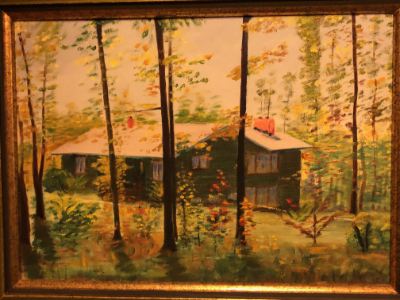
I had taken an option on one of two adjacent two acre lots at the northern end of the
rural town of Hebron, under fifteen minutes from the 160 acres of former shade grown
tobacco fields ("World's finest cigar wrapper!") that had been bought by the state for
Manchester Community College. I bought the plot on the hillside, heavily forested with oak
and hickory trees, rather than the adjacent grassy hilltop one with its beautiful view of
the hills to the east. The architect I had retained to help me with the plot selection
developed a set of construction plans from my choice of floor plans and elevations of
"Small Farm Houses" that had been published by the Architecture School of one of the Big
Ten Universities. I had made some changes to those plans since my hillside plot allowed
building into the side of the hill, thus getting a ground floor half above and half below
grade instead of a full basement which I would have had if I had bought the hilltop lot.
In mid-June I received the State-signed original of my employment contract. As soon as I
signed it I exercised my option on the plot with the forested hillside and had the
architect develop the construction plans and specifications. I went out to bid the first
of July. I moved into my house early in October [ed. note: he lived there until summer
2001]. The decision to become an academic proved to be a very good one.
Starting at MCC
On July 1, l969, I reported for work. Dr. Lowe greeted me and suggested that life would be a bit easier for both of us if we were on a first name basis. He gave me a quick overview of the College and of the Community College movement including its history and philosophy, both nationally and in Connecticut. Then came a discussion of the problems, and there were many, which I could anticipate while doing busness with other state agencies. In particular, I was warned that state procedures were based on the assumption that everyone doing business with the state is dishonest. After giving me a batch of pamphlets and books discussing various aspects of community colleges, he introduced me to the entire staff, both at the Keeney Street headquarters and elsewhere in the town.
I soon learned that in addition to planning the campus for the Manchester Community College, I would be responsible for its business office and working with the State Department of Public Works in developing lists of the furniture, instructional supplies, and equipment for current operations as well as for the new campus. There were three classrooms in the old school house, all with the original slate blackboards lining their walls. One was the president's office. It was separated from the second classroom, the business office, by both a smaller room for Fred's secretary, Eileen, who typed my hand written drafts, and a much larger room with a refrigerator, sink, the brown baggers' table and chairs, doors to the toilets, and a flight of stairs to the basement. The third classroom was perpendicular to the other two. It had three desks and chairs, for me, for the president's assistant, Saranne Murray, a brand new honors graduate of Lesley College who started work the same day I did, and for Twiggy, a very bright girl of about eighteen. She sorted mail, kept track of office supplies, and filled supply orders from faculty whose offices were scattered throughout the town. Al Brown, in his early sixties, drove the state car to deliver mail and supplies, cleaned our building, and did miscellaneous tasks, including teasing Twiggy. The Business Manager, Karl Happ, his male assistant, and staff of middle aged women with years of state service who had been with the college almost since its founding, took care of the minutiae of state regulations related to payroll, accounts payable, and procurement. A central administrative staff in Hartford wrote procedures for what ultimately became a twelve college system.
Early MCC Facilities
Manchester was a town of about 50,000 that had a large industrial base to its economy. The Cheney Mills had been the nation's largest silk mills but by the time I started with the College synthetic fibres had driven them out of business. It had several large mill buildings, some empty, many subdivided and rented. Its business offices had been in two adjacent brick buildings. The larger, a two story structure, had been bought by a local real estate developer and leased to the State for the college. It had been remodeled to house the Registrar's office, a few faculty offices, and classrooms of various sizes. The basement had a large room with cafeteria line and tables and chairs at one end and a small stage at the other. Several smaller basement rooms were used for storage. The front doors entered on a very large lobby with a staircase halfway up to a landing with two shorter sets of stairs which led up to opposite ends of the U shaped second floor corridor. The lobby walls and those of the two shorter staircases were covered by artwork by students and faculty and by occasional shows by Hartford area artists. Whether they liked art or not, students and visitors were exposed to it, often for the first time. The Stairwell Gallery served the College well.
The College used Manchester High School's chemistry, physics, and biology laboratories and a few classrooms after three PM. The office of the college's Dean of Students was also in the high school building, as was the college's small library. The Admissions Office, Acting Academic Dean's and a few faculty offices were in a large rented residence. Each faculty office had several desks and chairs shoehorned into it. I used to joke that each of the desk drawers was assigned to a different faculty member. The Art Studios were in dank space in the basement and somewhat brighter space in the attic. The Dean's secretary typed for the faculty on a time available basis.
Ed Bollinger joined the College as Director of Data Processing the same week that I did. The "Data Center" was in the basement of one of the Town's school buildings and consisted of a computer operator and a programmer, both on the Town's payroll. The College paid the rent for the early I.B.M. computer and key punch machine. The key punch was used by College staff, students and the Data Center staff to prepare data and programs for entry to a computer. The compiling was done at the University of Connecticut Data Center in Storrs, about 20 miles away. One of Al Brown's chores was to take trays of punched cards -- students', Ed Bollinger's, and the Town's -- to and from Storrs. Within a year of Ed's arrival he had written and installed programs to keep track of student academic records and transcripts. Ed's registration system provided, in a separate print-out for each student, a schedule of classes and their required texts. These were given to each student on receipt of tuition and fees which were calculated on the spot from the student's hand written enrollment data. The program also prepared class rosters for the faculty, which were used to keep track of each student's grades on quizzes and exams as well as mid-term and final grades. These rosters provided the input data from which student transcripts were kept current at the end of each semester. [ed. note: It probably took programming students a week to get a short program to work when they had to send their punch cards to Storrs and get numeric error codes back if there were any errors!]
Prior to my joining the College,the National Center for Higher Educational Statistics, (NCHEMS), had embarked on a massive program to determine costs of providing collegiate educations which could be used by federal and municipal agencies, as well as by the institutions themselves, to determine the costs of generating an hour of academic credit for each of their various academic units. Such information would be necessary for making cost/benefit analyses and for many other administrative purposes. Fred Lowe was anxious to obtain such information even before NCHEMS had defined the scope of its program, let alone the many terms which required precise definition before its output data could be used for comparisons among institutions or even within a single institution. Even enumerating the terms which needed that definition was a task that had to be completed before the monumental task of getting concensus on anything could begin. Fred decided that we wouldn't wait for NCHEMS and asked me to develop a system that we could use. By this time I realized that debate is the life blood of Academe, and meaningful debate requires debaters to agree to the terms of that debate, especially if that debate is relevant to the administration of the institution. After all, the Faculty Senate has its roots in ancient debating societies, the Roman Senate and before that in the Greek Academy. I had spent many years in the harsher environment of business and had learned that it is difficult to get acceptance of a proposal unless means of attaining that end has been planned and presented. In short, "The man with a plan is the man with the plan." Ed Bollinger proved invaluable in developing the plan which I discussed with both Harry Godi and Bob Fenn, respectively Dean of Students and Dean of Faculty. The plan which they accepted after involving their senior faculty members required coding all purchase requisitions and time cards with a multi digit identifier denoting cognizant organizational entity, e.g. ACADEMIC AFFAIRS; then the Division of Interest, e.g. BUSINESS CAREERS; next, the Departmen, HOTEL & FOOD SERVICE MANAGEMENT; and finally the Specific Course, PASTRY 103. Similarly for STUDENT AFFAIRS and ADMINISTRATIVE AFFAIRS.
Manchester was the first of the Connecticut Community Colleges to have a Data Center with a competent programmer as its leader, the first to offer courses in Computer Programming, and the first to have a computerized student registration system on line. Nevertheless, the Office of the Board of Trustees decided to develop a system-wide set of administrative and student record keeping programs so that all twelve colleges would be able to talk to each other and a central computer in a common language. The problem that in time became apparent was that the system was designed to satisfy the needs of the Central Office, but not those of the individual colleges and certainly not those slowly emerging from NCHEMS. Because of the lack of Central Office support, and the likelihood that NCHEMS would spend its time in trying to arrive at a commonly held set of goals, Manchester developed programs to satisfy its administrative needs and abandoned its early ambitious goals which would be useful for those engaged in institutional research. When I formally retired after fifteen years, the Central Office had not yet provided the individual colleges with a common set of administrative programs.
Starting to Plan the New Campus
As Manchester's student body grew, so did its faculty. I translated their combined needs from bodies into square feet of office, classroom, laboratory and special purpose space using conversion factors that I gleaned from the various publications that Fred had given me when I first signed on. Registration statistics came from the Registrar who gave me head counts of full time and part time students by semester for the years the college had existed, as well as the total of the credit hours of instruction generated by the two classes of students (full time, part time) each semester. Corrections to the raw data were applied depending on the values of the factors that converted lab hours to credit hours. Those factors depended on course content as well as local demographic and economic conditions. While some conversion factors might be in the literature, it was not clear that the same factor would apply even to sister colleges within the same system, hence I calculated them from our registrar's data. However, some factors such as the classroom gross area per student, were gleaned for general purpose classrooms from publications. Faculty comment, via Bob Fenn, the Acting Academic Dean, was solicited for various types of special purpose classrooms. I was sensitive to the fact that I was the only member of the staff with extensive industrial experience and that only two other staff members had doctorates, both in English Literature (Bob Richardson, Princeton, and Fred Lowe, Columbia). Hence, in dealing with the faculty, I had to walk on egg shells without showing it.
Several weeks before my first fall semester began, Fred hinted that it would would save a part time faculty salary if I would teach an elementary chemistry course as a freebie. I took his "hint" provided the lab was taught by some one else to whom I would send my syllabus. Further, the course should be late in the afternoon so as not to interfere with regular college business. That decision shielded me from the inevitable criticism from faculty, complaints that I really needed classroom experience in order to do my job well. If that criticism was ever voiced, it was by a pretty quiet voice. In addition to my regular job as Dean of Administration I taught a section of science practically every one of the fifteen years I was a full time employee. After several years I realized that altruism earned few brownie points, and got the college to pay me the regular part time lecturer fee per credit taught. I retired when I was 70 and continued teaching as a part time lecturer for an additional fourteen years. Frequently my course was under the aegis of the Extension Division of the College so that it could be offered off campus and evenings to serve those working daytime jobs. The course I preferred to teach, Physical Science, consisted of four units,one each of chemistry, physics, astronomy and geology. When a laboratory session was added to its syllabus, I stopped teaching it. Instead I taught physical science courses that did not have an associated lab: geology, astronomy, meteorology, oceanography, even elementary math. My own college courses, especially those in chemistry and physics, plus regular recreational reading of the American Scientist, Scientific American and Science News, a weekly for the layman, provided enough background to keep me from short-changing my students.
By the time my first summer at the College was over, I had pretty much learned how to do the conceptual design of a community college. All that remained to know was the educational philosophy of the institution as defined by the various categories of student, i.e., full time, part time; degree requirements in terms of credit and clock hours, and course distribution requirements for the various currricula. Fred was my source of information about those topics. Once the decision had been made to build a temporary campus that would be cheap, made of standard prefabricated modules that could be trucked in from the factory and assembled on concrete slabs, the architects' job was to design the electrical distribution and plumbing systems and to work out the details of building dimensions, space partioning and interior lighting. The design parameters I had developed from the literature simplified the architects job. He also had cognizance of the various tasks related to site development: landscaping, exterior lighting and parking; walks and vehicular traffic flow. His work had to meet building and fire codes and other construction-imposed details and the College's need for an attractive campus that was easy to maintain. I had to be sure that the architects' plans reflected our needs. I reviewed plans with Fred and the appropriate administrative officers. I also had to be the middleman between the college, the architect, the general contractor, and the state Department of Public Works. The DPW's resident engineer saw to it that materials and workmanship met specifications and that the campus would be ready at the start of the fall semester about a year hence.
The architectural firm selected by the Department of Public Works had headquarters in Washington and offices in several cities. Shortly after they were selected, Fred and I met in Washington with the principal architect assigned to our project to be sure that he understood the need for keeping on schedule and to establish the channel of communication. They had retained a small local firm of architects to supervise construction and to be sure that Connecticut building codes were followed. That firm would be represented at the weekly progress meetings chaired by the resident engineer. Planning was well along when the horizon suddenly got dark. An abutting landowner who lived in an ancient cut stone farm house objected to the idea of a college on land adjacent to his, and threatened suit. Fortunately, his request for an injunction was denied. However, early in December on the day before groundbreaking he blocked entry to the site by padlocking a heavy chain around trees on opposite sides of the access road. Fortunately the College Security Chief was at the site early. He got the State Police to cut the chain well before the start of the groundbreaking ceremony.
The Temporary Campus
By this time, the College had oozed into eleven locations in Manchester. The President's office was on Keeney Street. The classrooms and other offices were on an office building on Hartford Road. There was a College Bookstore. Faculty offices were in four sites: two commercial buildings on Main Street and two large houses on E. Center Street. Laboratories and a few classrooms were in the High School but their schedule meant that our use started at four PM. The Data Center and additional classrooms were in four of the Town's school buildings. MCC vacated all except the Hartford Road building when the "Temporary Campus" was completed. Faculty and staff played musical chairs, most moving into the new buildings while others moved into just vacated space at Hartford Road. With the cooperation of the College staff, who packed their belongings in cartons they got from their friendly neighborhood liquor store, and of the professional movers, the move went well. Only one carton was lost; it belonged to the Academic Dean and came to light a year later. It had been misaddressed.
I had called the vendors of equipment such as office desks and chairs, bookstore shelving, chemical glassware and balances, and equipment for a custodial staff, all of whom assured me that deliveries would be made during the week prior to our moving. Bookstore shelving was delivered, assembled, and text books and supplies shelved as scheduled. Deliveries of classroom and office equipment and office supplies were also timely, all except for classroom chairs. A week before the scheduled delivery date their maker had called to state that delivery would be delayed until a few days after the start of classes. The best solution we worked out was for delivery to be made on the Sunday immediately before the start of classes, but it would be short by about a hundred tablet arm chairs. Ted Madden, the Supt. of Buildings and Grounds, who had signed on a few weeks earlier, and I followed the delivery trucks around the campus access road that Sunday putting the chairs into the classrooms as fast as they were handed down from the trucks. We made sure that 10% of the required number of tablet arm chairs put into each class- room were left handed. After the trucks had been unloaded I called a previously alerted local undertaker who deliverd enough folding chairs to make up the deficiencies. We started classes on time.
Building the New Campus
The College had been growing by several percent per year and the old temporary campus was rapidly getting too small, especially for those courses such as art, music, and data processing which needed special purpose classrooms. While we were not threatened by loss of accreditation by the New England Association of Schools and Colleges, they had made it clear that some of our facilities, especially the library and cafeteria, needed substantial enlargement. The original Master Plan for the development of the College was made well before the Temporary Campus was built. It had used many assumptions about rate of enrollment growth and the distribution of students among the many academic and vocational programs we offered or would offer as the needs of the communities we served changed. By now, though, those assumptions had become quite obsolete.
The path from our perception of facilities needs to completion of construction was long and full of pitfalls that had to be avoided. First came development of new educational specifications which defined our philosophy as an institution. Next came tables of projected enrollment by program and the details of the various physical spaces needed to satisfy those tables. Equipment, from that needed to set up instructional kitchens and dining rooms to computers for the rapidly expanding needs of data processing classes as well as for Business Office and Registrar's use, had to be identified by maker and model number and costed out. Construction and site development costs had to be estimated by the architects and the entire package presented to the Community College Board of Trustees for their approval and submission to the Commission of Higher Education for review and ultimate submission to the State Bonding Commission by the State Department of Public Works. The expertise of members of the various agencies involved in the review and consequent modification of the educational specifications including the cost estimates had been solicited as much to avoid out of joint noses as for the intrinsic value of their comments. Then, after the Governor approved the entire package, his staff included all the estimated project costs as line items in his annual Budget to be submitted to the Legislature. For those aghast at all the red tape and repetition of reviews and approvals, it is appropriate to note that the same process, but with different names for the functions and officials involved, is followed by industry for its major projects. One of the reasons industrial and commercial construction projects move much faster than public ones is that many of the various steps done sequentially in the public case are done in parallel when stockholders' money is involved. The jealousies, backbiting, and power struggles in the private case are paralled in public projects but then go under the name of politics and laundry is often washed in public for its owner.
In drafting the new Educational Specs. the old ones were carefully reviewed and changes made in the originals to reflect the changes that time had brought about. The Board of Trustees had budgeted for our planning costs, primarily those for an architect to draft preliminary plans showing exterior views of the project, interior partitions, especially those defining classrooms, laboratories, and offices, but not structural details. All rooms on the preliminary plans were numbered arbitrarily and worksheets were numbered to correspond. The worksheets for special purpose space had room for the prospective occupant to insert the appropriate data, e.g. number of occupants, room area per occupant, type of lighting, number, sizes and locations of blackboards, type of floor covering, and lots of space for "Special Requirements". The deans reviewed the worksheets prepared by their people, and, if necessary, I would negotiate with the deans on requirements I deemed to be unrealistic. The worksheets were finally incorporated into the Educational Specifications after rigorous review by the deans, myself and the President's Office. They provided the raw data used by my office to compile the list of new equipment. The various documents were reviewed with the Facilities Coordinator in the Trustees' office. The final version of the Ed. Specs. was used by the architect, in conjunction with the State Department of Public Works, in developing the building plans. Finally bids were solicited from a pre-approved list of contractors and the construction contract, with a completion date in the spring of 1984, awarded. I attended the weekly progress meetings of the State's Construction Supervisor, the architect and the contractor's construction boss and followed actual construction closely. Change orders were inevitable and costly of time and money, and were prepared and submitted by my office. Since I was going to retire on June 30, 1984, five weeks after I turned 70, my ego required that the job be completed on schedule, and within budget. Both goals were met. The key to that unusual accomplishment, I am sure, was the careful and cooperative attitude of the entire college community starting with faculty and staff inputs to preparation and review of the Educational Specifications.
There still were loose ends that had to be tied up before my retirement. First, there was the matter of equipment to be specified and procured. Then, there was the 1% of the contracted cost for art, as specified by statute, that had to be contracted for with the College's concurrence. The latter task involved convening a College ad hoc committee whose representative would sit with the State Agency supervising the program. That agency selected works proposed by a pre-selected group of artists. The College Committee, chaired by the Dean of Students, would recommend suitable sites on the campus being sure that underground utility lines did not interfere with foundations for a massive piece of sculpture or that the ceiling could support a heavy mobile, or the walls a large framed woven work.
The new equipment had been specified for the special purpose rooms by faculty or staff members with concurrence of theappropriate dean and reviewed by my office to be sure that proper building services would be available. Useable classroom and office furniture had to be subtracted from the totals of such items required for the new building and put on a master list for procurement by the State Purchasing Department. Except for some of the Buildings and Grounds equipment and new furniture and drapes for the Office of the President, my involvement thereafter was largely to act as middleman in resolving problems between the requisitioner and State Purchasing.
The printing calculators provided for student use in each of the two classrooms of thirty student desks in each were top-of-the-line electro-mechanical monsters of the time. There were about five manufacturers who submitted bids on almost identical machines. An order for sixty machines at an average cost close to $600 each whetted the interest of the regional sales managers who would call to tell me what their written bids would be and to find out how their bids stacked up competitively. My response to all, "You are high," without being more specific would result in a round of formal bids superseding the earlier ones. Finally the bids were opened publicly. Soon I was asked to explain my role in the procurement to a group of Purchasing Department brass and an assistant attorney general. Apparently one of the losing bidders mistakenly thought he would have been low if I had not given his verbal statement to the winning competitor. All that I did was legal and ethical and accomplished its goal of saving the State several thousand dollars. Thereafter I continued to confine my dealings with prospective vendors to responding only to technical questions. Within a few months of delivery of the electro-mechanical calculators, the first transistorized printing calculators came on the market. Their prices were several hundred dollars less, each, than those we had just bought. It was clear that competition was fiercer than usual in order to clear out what would soon be obsolete inventory.
I had, of course, told the President my plans to retire several months before June 30, when my contract ended with the end of the fiscal year, 15 years, give or take a few days, after I had started work in the old three room school house. My successor, Tom Bavier, had been the President's Assistant for a few years. Late in May I started exposing him to the responsibilities he would inherit. He grabbed hold rapidly and well. By the last week in June the building was completed, except for several punch list items, and formally accepted by the State. I moved into my new office three days before month's end and spent the morning of my last day at the college and that afternoon at the State Office Building, Hartford, saying my goodbyes to the many people with whom I had worked.
The State parking lot I usually used in Hartford was full so I parked a long block away and bought two hours worth of time. I was about a hundred yards and a few minutes from my car and closing fast when a squad car pulled alongside. By the time I got to it the cop was tucking the parking ticket under my windshield wiper. Sic transit fifteen bucks.